The Silent Signs Your Body Is Trying to Tell You Something
Contents

They're easy to brush off. "I just don't walk as far as I used to." "I've stopped driving at night." "My partner handles the bills now — it's just easier."
These phrases feel like small admissions of getting older. Normal things. Inevitable things. But as Dr. Cheryl Johnson, our head geriatrician at Age Brightly, explains — normal doesn't always mean harmless.
Each of those statements can be an early signal of something clinically significant. Stopping long walks might reflect early muscle loss. Avoiding night driving often points to vision or depth-perception changes. Handing over the bills can be the first sign of subtle cognitive shift. Individually, they're easy to miss. Together, they paint a picture that a trained geriatrician reads very differently to how we read it ourselves.
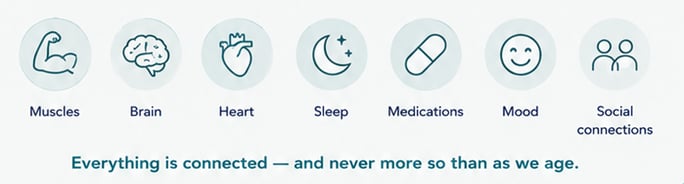
Geriatricians — the specialists who focus entirely on older person health — understand that aging isn't one disease. It's a complex interaction between dozens of systems: your muscles, your brain, your heart, your sleep, your medications, your mood, your social connections. When one domain comes under pressure, it rarely stays contained.
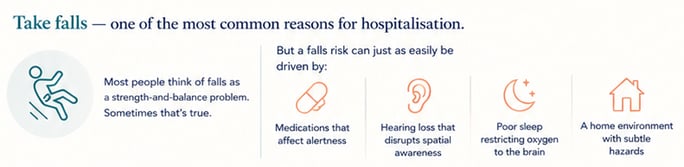
Take falls, one of the most common reasons older people end up in hospital. Most people think of falls as a strength-and-balance problem. Sometimes that's true. But a falls risk can just as easily be driven by medications that affect alertness, a hearing loss that disrupts spatial awareness, poor sleep restricting oxygen to the brain, or a home environment with subtle hazards. Address the wrong cause and you've solved nothing.
This is why geriatricians talk about "whole of person" care. You can't look at the knee that gave way without understanding the sleep patterns, the medication list, and the cognitive function of the person attached to it. Everything is connected — and never more so than as we age.
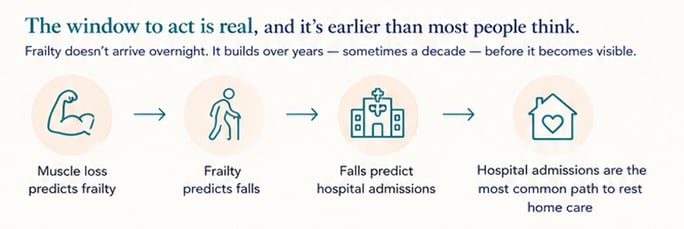
The window to act is real, and it's earlier than most people think. Frailty doesn't arrive overnight. It builds over years — sometimes a decade — before it becomes visible. Muscle loss predicts frailty. Frailty predicts falls. Falls predict hospital admissions. Hospital admissions are the most common path to rest home care.
But here's what that chain also tells us: there are multiple points along the way where intervention works. Grip strength is measurable. Cognitive change is detectable. Bone density is assessable. Medication interactions are reviewable. These aren't mysteries — they're data points, and skilled clinicians know how to read them early.
The question isn't whether decline is happening. Some of it is a normal part of aging. The question is whether it's being detected, understood, and actively managed — or quietly compounding in the background while life carries on as usual.