Relationship‑Led Healthcare: How It Differs from Concierge Medicine
Contents
As more New Zealanders seek a more personalised, proactive approach to their health—particularly later in life—new models of care are gaining attention. Two of the most commonly discussed are concierge medicine and relationship‑led healthcare. While they may appear similar at first glance, they differ significantly in philosophy, structure and outcomes.
Understanding these differences is essential for anyone evaluating their healthcare options, especially those focused on ageing well and maintaining independence.
What Is Concierge Medicine?
Concierge medicine, sometimes referred to as private membership medicine, is a model in which patients pay an ongoing fee—often monthly or annually—for enhanced access to a doctor. In New Zealand, services such as Drips NZ have popularised this approach.
Typically, concierge medicine offers:
- Faster appointments and extended consultation times
- Direct communication with a doctor (e.g. phone, text or email)
- Same-day or next-day access to care
- A more personalised service compared to standard general practice
The core appeal of concierge medicine NZ lies in convenience and accessibility. Patients often value the ability to reach their doctor quickly and avoid long wait times. However, the model remains largely reactive—focused on diagnosing and treating issues as they arise, albeit with greater ease and attention.
What Is Relationship‑Led Healthcare?
Relationship‑led healthcare takes a broader, more holistic view of health. Rather than centring on access alone, it is built around a long-term partnership between patient and clinician, with a strong emphasis on prevention, early detection and personalised care planning.
Providers such as Brightly and Aurum Health exemplify this model in New Zealand.
Key features of relationship‑led healthcare include:
- A dedicated clinician (often a specialist such as a geriatrician)
- Deep, ongoing understanding of a patient’s health history, goals and risks
- Comprehensive baseline assessments using extensive biomarker data
- Personalised care plans that evolve over time
- Proactive monitoring to prevent decline rather than respond to illness
At its core, relationship‑led healthcare is about continuity and foresight. It prioritises helping individuals stay well for longer, rather than simply addressing problems when they occur.
A Side-by-Side Comparison
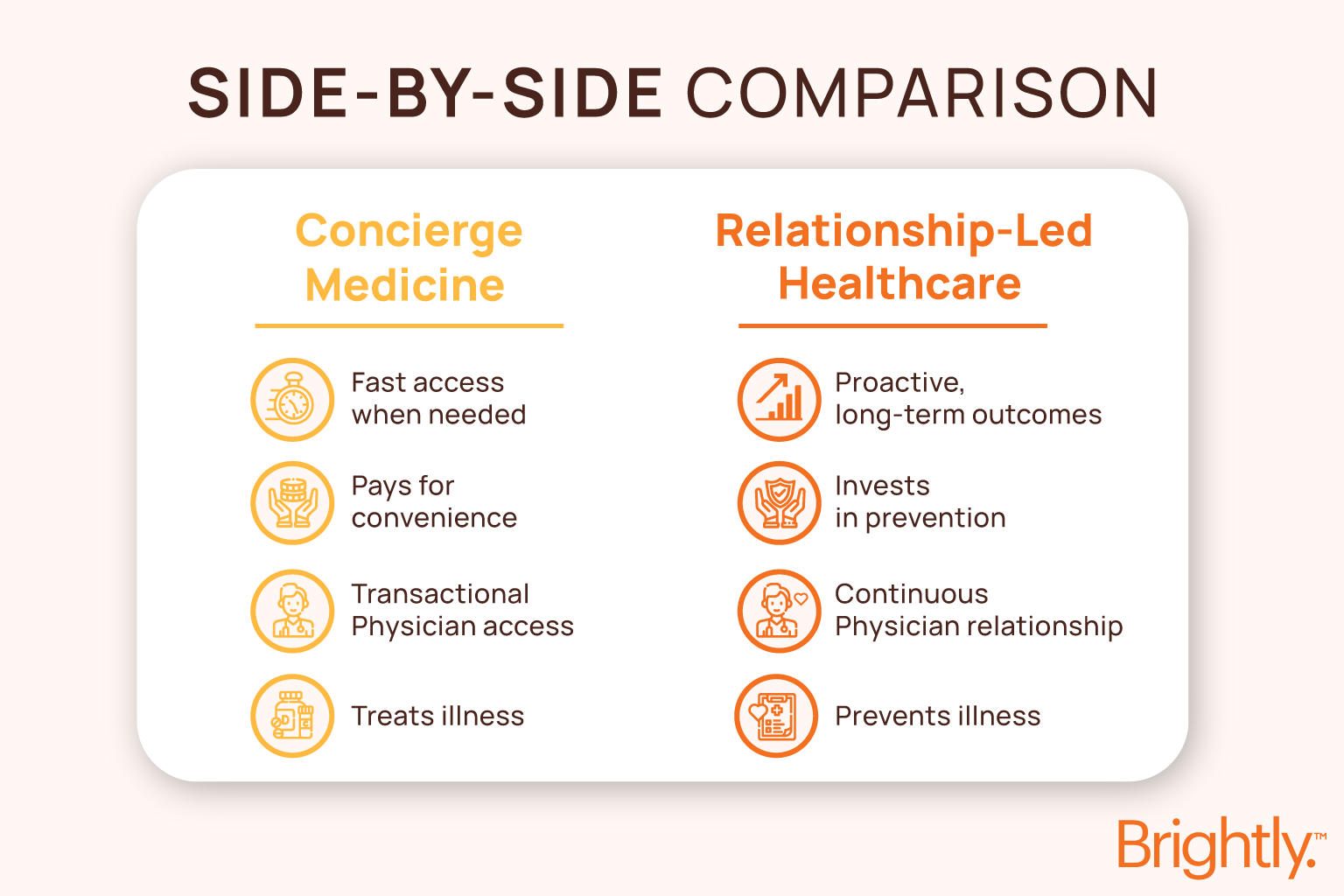
Although both models offer a more premium experience than traditional care, their underlying purpose differs in meaningful ways.
1. Focus: Access vs Outcomes
Concierge medicine is primarily focused on access. The value lies in being able to see a doctor quickly, communicate easily and receive prompt treatment.
Relationship‑led healthcare, by contrast, is focused on long-term health outcomes. Access is important, but it is not the end goal—it is a tool used to support proactive, personalised care.
For example, a concierge patient may contact their doctor when symptoms arise. A relationship‑led healthcare member is more likely to have those risks identified and managed well before symptoms develop.
2. Cost Structure and Value
Both models involve a membership fee, but what that fee delivers differs.
In concierge medicine NZ, the fee typically covers enhanced access and service. Clinical care itself may still be episodic, with additional tests or referrals billed separately.
In relationship‑led healthcare, the membership often includes structured programmes—such as comprehensive baseline assessments and ongoing health planning—that are designed to deliver long-term value.
Rather than paying for convenience alone, members are investing in a preventative health strategy tailored to their individual needs.
3. Physician Access vs Continuity of Care
Concierge medicine improves access to a doctor, but the relationship may still be relatively transactional. Interactions are often driven by immediate concerns.
Relationship‑led healthcare places continuity at the centre. Patients typically work with the same clinician over time, allowing for a deeper understanding of their health trajectory.
This continuity is particularly valuable for older adults, where subtle changes in function, cognition or physiology can signal early decline. A clinician who knows the patient well is better equipped to recognise and act on these changes.
4. Prevention vs Treatment
Perhaps the most significant difference lies in the emphasis on prevention.
Concierge medicine enhances the treatment experience—it makes it easier and more comfortable to receive care when needed.
Relationship‑led healthcare, however, shifts the focus upstream. It seeks to identify risks early, intervene sooner and delay or prevent the onset of chronic conditions.
This preventative approach is especially relevant for those over 60, where maintaining healthspan—the years lived in good health—is a key priority.
The Role of Personalised Care
Both models use the language of personalised care, but they apply it differently.
In concierge medicine, personalised care often refers to more time with a doctor and greater responsiveness to patient concerns.
In relationship‑led healthcare, personalised care is data-driven and longitudinal. It involves collecting detailed health information, interpreting it in context and using it to guide a tailored plan.
Brightly’s approach, for example, includes its Baseline+™ assessment, which gathers over 100 biomarkers to create a comprehensive picture of an individual’s health. These insights are then used to develop a HealthPlan™ that evolves as the patient’s needs change.
This level of personalisation goes beyond convenience—it enables targeted interventions that can meaningfully influence long-term outcomes.
A Geriatrician‑Led Approach to Ageing Well
One of the defining features of relationship‑led healthcare, particularly in the Brightly model, is the involvement of geriatricians—specialists in the care of older adults.
Geriatricians are uniquely trained to manage the complexity of ageing, including multiple conditions, medication interactions and functional decline. Their expertise allows for a more nuanced and integrated approach to care.
In a relationship‑led model:
- Care is coordinated across physical, cognitive and functional domains
- Subtle changes in health are identified early
- Interventions are prioritised based on what matters most to the patient
- The goal is to maintain independence and quality of life over time
This contrasts with more generalist models, where care may be fragmented or focused on individual conditions rather than the whole person.
By building a long-term relationship with a geriatrician, patients benefit from continuity, expertise and a proactive strategy tailored to ageing well.
Why the Distinction Matters
For individuals and families exploring healthcare options, the distinction between these models is more than academic—it has real implications for outcomes, experience and value.
Concierge medicine NZ may be an excellent fit for those who prioritise convenience, rapid access and a more comfortable treatment experience.
Relationship‑led healthcare may be better suited to those who want a structured, preventative approach—particularly if they are navigating the complexities of ageing or seeking to stay independent for as long as possible.
The choice ultimately depends on what matters most: ease of access today, or a strategic approach to health over the years ahead.
Choosing the Right Model for You
When evaluating your options, it can be helpful to ask a few key questions:
- Am I primarily looking for faster access to care, or long-term health guidance?
- Do I want support in preventing illness, or managing it when it arises?
- How important is continuity with the same clinician over time?
- Am I seeking a personalised care plan, or simply more responsive service?
There is no one-size-fits-all answer. Both concierge medicine and relationship‑led healthcare offer valuable alternatives to traditional models.
However, for those focused on ageing well, maintaining independence and making informed, proactive decisions about their health, relationship‑led healthcare provides a compelling path forward.
By combining deep clinical relationships, comprehensive data and a preventative mindset, it offers not just better access—but a fundamentally different way of thinking about care.
If you are considering a more personalised approach to your health, speaking with a provider about how their model supports long-term wellbeing can be a valuable first step.
Understanding how care is delivered—not just when you need it, but before you do—can make all the difference in the years ahead.